ChessEver News · July 25, 2026
FIDE presidential elections: A history from 1924 to the 2026 race
How FIDE chose seven elected presidents in 102 years, why one-federation, one-vote shaped the office, and what makes the 2026 race different.
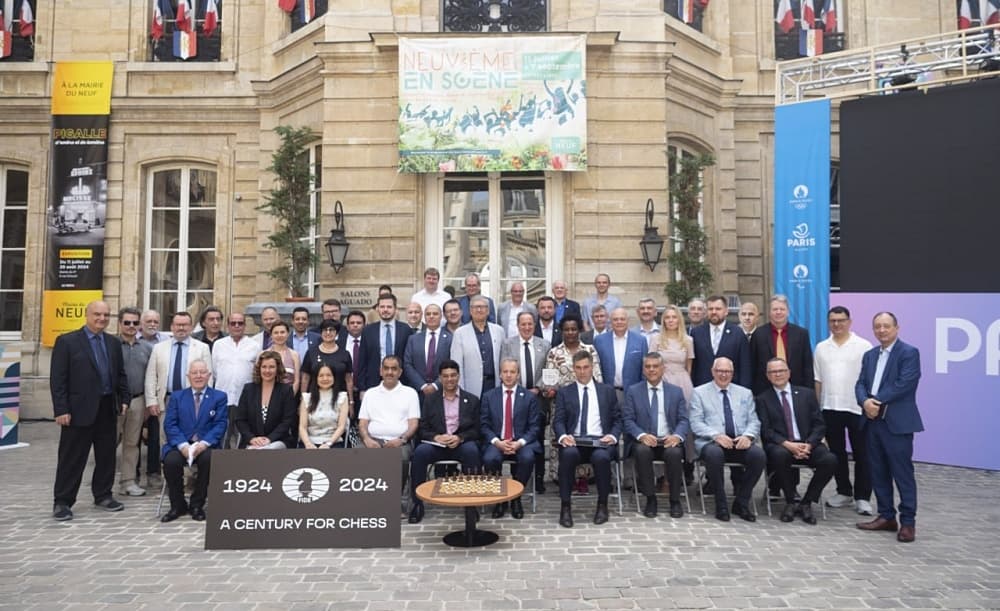
FIDE's 2026 presidential election was already set to be one of the most consequential in the federation's history. Then the European Union sanctioned Arkady Dvorkovich, the incumbent temporarily suspended his presidential powers, and Viswanathan Anand became interim president. Within a day, the shape of the race changed again.
The vote is scheduled for September 26, 2026, during the FIDE General Assembly in Samarkand, Uzbekistan. Presidential tickets must reach FIDE by July 26 at 18:00 CET, and FIDE's first list of validated candidacies is due on July 28. Until that validation is complete, campaign announcements are not the same as the final ballot.
To understand why this election matters, it helps to look beyond the latest headlines. FIDE has had only seven elected presidents in 102 years. Several remained in office for decades; some elections became global political contests; and twice in the last eleven years, sanctions against a sitting president affected the federation's leadership and operations.
THE SHORT ANSWER: WHO LEADS FIDE NOW?
Dvorkovich remains FIDE's elected president, but on July 23 he voluntarily suspended the exercise of his rights, duties and powers after the EU placed him on its sanctions list. The FIDE Council accepted and ratified that decision. Anand, the elected deputy president since 2022, is exercising the president's powers on an interim basis.
That distinction matters. Dvorkovich did not resign, and Anand was not elected as a new FIDE president. The temporary transfer follows FIDE's succession structure while the sanctions remain in force and the 2026 election approaches.
ChessEver reported the immediate transition in Viswanathan Anand becomes interim FIDE president after Dvorkovich suspension, followed by Dvorkovich drops FIDE re-election bid as Turlov enters race.
HOW A FIDE PRESIDENTIAL ELECTION WORKS
FIDE is not a direct democracy of chess players. Its General Assembly is made up of national member federations, and each federation represented at the meeting has one vote. A country with millions of chess players therefore has the same formal vote as a much smaller federation.
Candidates run on a joint ticket for president and deputy president. Each ticket must be endorsed by at least five and no more than eight member federations, including at least one federation from each of FIDE's four continents. Voting is by secret ballot. If three or more tickets run, a ticket needs 50% plus one of votes cast to win in the first ballot; otherwise the top two advance to a second ballot. The complete procedure appears in the FIDE Electoral Rules.
This one-federation, one-vote system explains why FIDE campaigns are global coalition-building exercises. Candidates must persuade delegates across Europe, Asia, Africa and the Americas rather than simply win the support of elite players or the largest chess nations.
FIDE'S SEVEN ELECTED PRESIDENTS
FIDE's official archive records the presidential succession: FIDE Presidents.
• Alexander Rueb — 1924-1949
• Folke Rogard — 1949-1970
• Max Euwe — 1970-1978
• Friðrik Ólafsson — 1978-1982
• Florencio Campomanes — 1982-1995
• Kirsan Ilyumzhinov — 1995-2018
• Arkady Dvorkovich — 2018-present, with powers temporarily suspended in 2026
Anand is the interim president in 2026, but he is not an eighth elected president.
1924-1970: FROM A PARIS FEDERATION TO A GLOBAL AUTHORITY
FIDE was founded in Paris on July 20, 1924. Dutch lawyer and chess organizer Alexander Rueb became its first president and served for 25 years. The organization he led was far smaller and less powerful than today's federation. It coordinated international chess, but the world championship was still largely controlled through private arrangements involving the champion.
Sweden's Folke Rogard succeeded Rueb in 1949 and remained president until 1970. Under Rogard, FIDE's authority expanded. It became the central organizer of the world championship cycle after Alexander Alekhine's death, standardized international titles, and developed the Olympiad and qualification system into permanent institutions.
Those first two presidencies covered 46 years. Long tenure was not an exception in FIDE's early history; it was the structure.
1970-1978: MAX EUWE AND THE POLITICS OF THE WORLD CHAMPIONSHIP
Former world champion Max Euwe was elected in 1970. His presidency coincided with the 1972 Fischer-Spassky match, the Cold War's most famous chess event, and the turbulent aftermath of Bobby Fischer's championship.
Euwe tried to balance sporting rules, national federations and political pressure. The office was no longer ceremonial administration. Decisions about match conditions, qualification and the champion affected global attention, state interests and the legitimacy of the chess title itself.
When Euwe's term ended in 1978, the presidency passed to Icelandic grandmaster and lawyer Friðrik Ólafsson. FIDE's official obituary records that Ólafsson won the election against Svetozar Gligorić and Narciso Rabell Méndez. It was a rare moment when a leading player took direct control of the federation.
1978-1982: FRIÐRIK ÓLAFSSON'S SHORT PRESIDENCY
Ólafsson served only one four-year term. His presidency included the politically charged 1981 Karpov-Korchnoi world championship in Merano. He had tried to secure the release of Korchnoi's family from the Soviet Union, a stand that sharpened conflict with Soviet chess officials.
At the 1982 FIDE Congress in Lucerne, Florencio Campomanes defeated the incumbent. The result shifted FIDE's center of gravity. Campomanes, from the Philippines, became the first Asian president and would hold office for 13 years.
1982-1995: CAMPOMANES AND THE AGE OF PRESIDENTIAL POWER
Campomanes's presidency covered the rise of Garry Kasparov, the famous Karpov-Kasparov matches and the 1993 split in the world championship. His most controversial sporting decision came in 1985, when he stopped the first Karpov-Kasparov match after 48 games and ordered a new match later that year.
By then, a FIDE president could influence not only administration but the course of chess history. Campomanes built alliances across developing chess nations and repeatedly survived political opposition inside the federation. He was re-elected again in 1994, but his final term did not last.
At an extraordinary congress in Paris in November 1995, Campomanes stepped aside and Kirsan Ilyumzhinov, then president of the Russian republic of Kalmykia, was elected. FIDE's official presidential record marks 1995 as the transfer of power, although the transition did not follow the clean four-year rhythm familiar today.
1995-2018: ILYUMZHINOV'S 23-YEAR ERA
Ilyumzhinov's presidency was the second-longest in FIDE history. He brought personal financing and ambitious events, reunited the world championship title in 2006, and expanded FIDE's reach. His tenure was also defined by repeated governance disputes, controversial public claims and increasingly organized opposition.
Three elections show how durable his federation network became:
• 2006, Turin: Ilyumzhinov defeated Bessel Kok 96-54 (contemporary report).
• 2010, Khanty-Mansiysk: he defeated former world champion Anatoly Karpov 95-55 (official FIDE result). Kasparov backed Karpov's campaign.
• 2014, Tromsø: he defeated Kasparov 110-61 (official election result). The campaign became a highly visible argument over governance, development money and the future of international chess.
Those were not votes by professional players. They were votes by national federations, and Ilyumzhinov repeatedly proved stronger at assembling that electorate.
THE FIRST SANCTIONS CRISIS
In November 2015, the United States Treasury sanctioned Ilyumzhinov, saying he had materially assisted or acted for or on behalf of the Syrian government, the Central Bank of Syria and designated Syrian officials. Ilyumzhinov rejected the allegations.
The consequences reached FIDE. He withdrew from legal, financial and business operations while Deputy President Georgios Makropoulos assumed those functions. In 2018, FIDE said the sanctions had created a dire operational situation; its Presidential Board asked Ilyumzhinov to resign by a 14-1 vote. FIDE also said its banking problems were connected to the president's sanctioned status.
Ilyumzhinov ultimately withdrew from the 2018 election. The episode established a precedent that has become newly relevant in 2026: sanctions against an individual president can become an institutional problem for a Swiss-based international sports federation.
2018: DVORKOVICH DEFEATS THE OLD ESTABLISHMENT
The 2018 election in Batumi offered a genuine change of era. Three figures entered the campaign: Arkady Dvorkovich, FIDE Deputy President Georgios Makropoulos and English grandmaster Nigel Short. Short withdrew before the ballot and backed Dvorkovich.
Dvorkovich defeated Makropoulos 103-78 (official FIDE announcement). His ticket promised professional management, commercial growth and governance reform after the institutional strain of the late Ilyumzhinov period.
The change was significant. For the first time since 1995, FIDE had a new president; for the first time since 1982, the office changed through a scheduled competitive election rather than an extraordinary mid-cycle transition.
2022: DVORKOVICH WINS A SECOND TERM, ANAND BECOMES DEPUTY
Four years later, Dvorkovich ran with Anand as his deputy-president candidate. The election took place in Chennai on August 7, 2022, months after Russia's full-scale invasion of Ukraine. Ukrainian grandmaster Andrii Baryshpolets challenged him, with Peter Heine Nielsen as his proposed deputy.
Dvorkovich won 157-16 (official FIDE result). Two other tickets withdrew before voting. The margin showed that controversy in public debate did not translate into a close contest among federation delegates. Anand's election as deputy president also placed one of chess's most respected former world champions directly in the succession line.
2023: FIDE REMOVES THE TWO-TERM LIMIT
A major rule change followed. FIDE had introduced a two-term presidential limit after the Ilyumzhinov era. But at the online General Assembly on December 17, 2023, delegates approved decision GA-2023/08, deleting Article 18.12 of the FIDE Charter. That removed the presidential term cap and made a third Dvorkovich candidacy possible in 2026.
This matters historically. FIDE spent 57 of the 69 years from 1949 to 2018 under just three long-serving presidents — Rogard, Campomanes and Ilyumzhinov — and term limits had been presented as protection against another extended presidency. Their removal returned the decision entirely to future General Assemblies.
2026: SANCTIONS, SUSPENSION AND AN OPEN RACE
Dvorkovich initially prepared to seek another term. The race changed on July 23, when the EU formally included him in its latest Russia sanctions package. EU Regulation 2026/1843 imposed an asset freeze and travel restrictions. Dvorkovich said the decision was unjust and that he would challenge it through legal channels, while temporarily suspending his FIDE powers to protect the federation (official FIDE statement).
FIDE then placed Anand in interim charge. Dvorkovich subsequently said he would not continue his re-election bid, while businessman Timur Turlov announced a presidential campaign with Anand as his proposed deputy. Other campaigns have also been active, but the authoritative field is the list validated by FIDE's Electoral Commission after the nomination deadline.
The election itself is set for September 26 under the official 2026 election timeline. The decisive voters will again be national federations, each carrying one vote. If no ticket wins a first-ballot majority in a field of three or more, the leading two will proceed to a runoff.
WHY THE 2026 ELECTION IS HISTORICALLY DIFFERENT
The current crisis resembles 2015-2018, but it is not identical. Ilyumzhinov stayed formally in office while losing operational authority over a prolonged conflict with his own board. Dvorkovich voluntarily suspended his powers immediately after the EU listing, and FIDE ratified a transfer to its elected deputy president.
The timing is also different. FIDE is only weeks away from an election, the final ballot is still being formed, and Anand is both interim president and a central figure in the emerging campaign. That combination has no close precedent in FIDE's 102-year history.
The vote will answer more than who occupies the office. It will test whether the federation's delegates want continuity with the management model built since 2018, a different governing coalition, or a broader constitutional response to the second sanctions crisis involving a FIDE president in little more than a decade.
FIDE ELECTION FAQ
WHEN IS THE 2026 FIDE PRESIDENTIAL ELECTION?
The election is scheduled for September 26, 2026, at the FIDE General Assembly in Samarkand, Uzbekistan.
WHO VOTES FOR THE FIDE PRESIDENT?
Eligible FIDE member federations vote through their delegates or presidents. Each represented federation has one vote. Chess players and fans do not vote directly.
WHO IS THE CURRENT FIDE PRESIDENT?
Arkady Dvorkovich remains the elected president but has temporarily suspended his powers. Deputy President Viswanathan Anand is exercising the president's functions on an interim basis.
WAS DVORKOVICH REMOVED FROM OFFICE?
No. He voluntarily suspended the exercise of his presidential rights, duties and powers after the EU sanctions decision. The FIDE Council ratified the arrangement. Suspension of powers is not the same as resignation or removal.
CAN DVORKOVICH LEGALLY SEEK A THIRD TERM?
FIDE removed its two-term presidential limit in 2023, so the former term-cap rule would not have barred a third candidacy. Dvorkovich has since said he will not continue his 2026 re-election bid. The sanctions question and formal electoral eligibility are separate legal issues.
HOW MANY PRESIDENTS HAS FIDE HAD?
FIDE has had seven elected presidents since 1924. Anand's interim role in 2026 does not make him an eighth elected president.
WHY IS THE FIDE PRESIDENCY IMPORTANT?
FIDE governs the world championship system, Olympiads, international titles, ratings and a global network of national federations. Its president is the federation's chief representative and a central figure in its strategy, diplomacy and commercial relationships.
The 2026 election will be another one-country, one-vote contest. But after a century of long presidencies, disputed transitions, global campaigns and two sanctions crises, it may also become a referendum on how FIDE protects its independence when the politics surrounding its leader threaten the institution itself.
SOURCES AND FURTHER READING
• FIDE 2023 General Assembly decisions
• Official 2026 election timeline
• FIDE statement on Dvorkovich's suspension and Anand's interim role
• U.S. Treasury's 2015 Ilyumzhinov designation
Photo: Niki Riga / FIDE.